Journal
27.04.2021
Housing policy
Sustainability
Never demolish mantra risks demonising architects
I want to be absolutely clear: I am delighted to see Lacaton & Vassal win the Pritzker Prize. Their work is thoughtful and sensitive with a clear social purpose, and their win – like Mikhail Riches’ Stirling Prize - signals a welcome shift towards recognising ethical and responsible architecture.
Following on from Lacaton & Vassal’s success commentators have jumped on their social media-friendly “never demolish, never remove” maxim. This soundbite is perfect for the socials but ignores real world complexities and risks demonising anyone who dares to consider demolishing an existing building. Some of our recent estate regeneration projects – where demolition vs. retention is a major factor - confront this very issue.
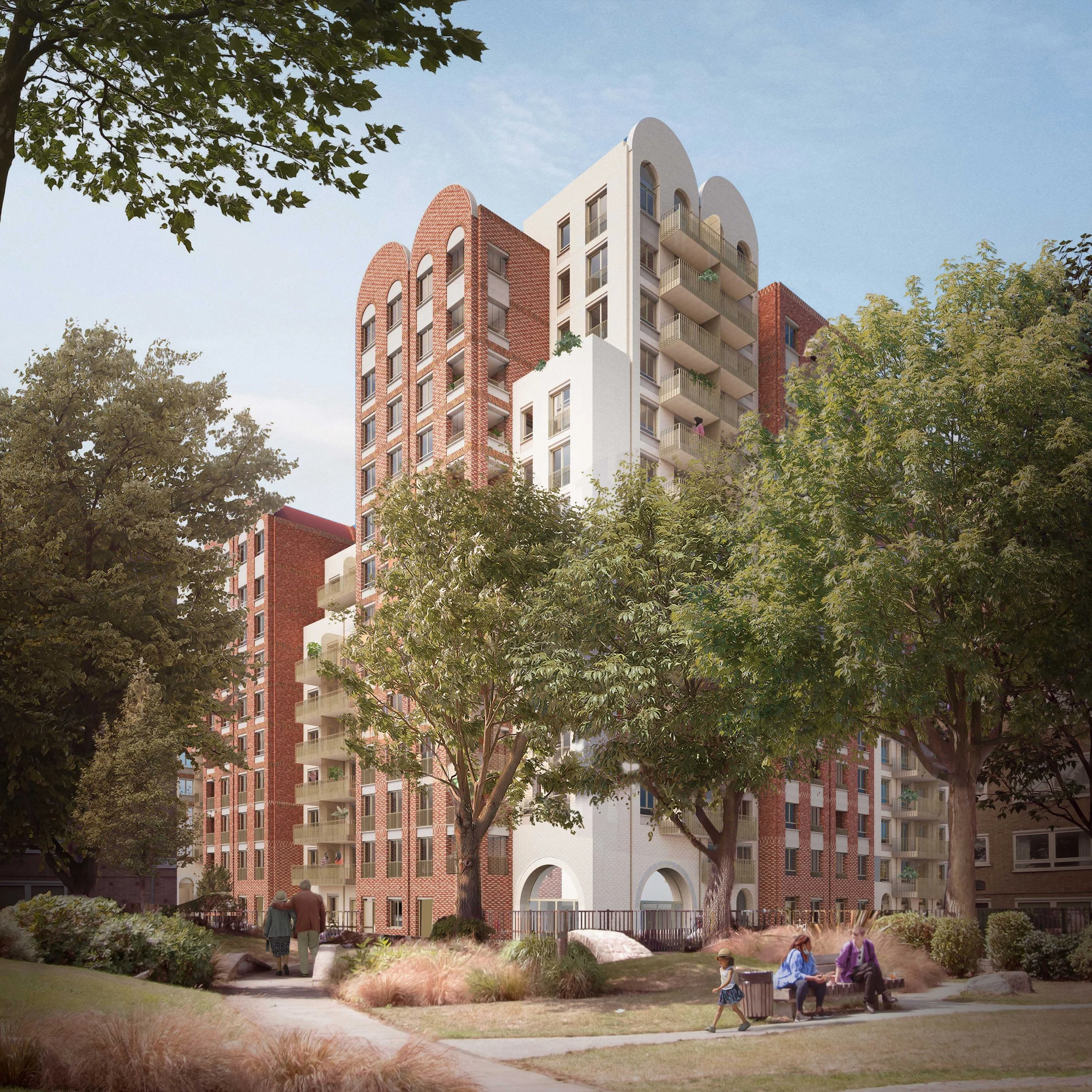
Church Street in Westminster may be a stone’s throw from some of the best-heeled addresses in central London but is one of the most deprived wards in the UK. Here we are consulting on proposals to deliver over 1,100 new homes (50% affordable) alongside retail, affordable workspace, a library, infrastructure supporting the historic street market and public open space. The development will see the demolition of 17 post-war housing blocks comprising around 430 existing homes.
From the outset of the project in 2018, Westminster City Council tasked us, together with Mae and Arcadis, to explore four options: retention, enhanced retention, part retention/part newbuild, and newbuild. Every existing building was assessed in terms of its projected lifespan, qualitative aspects (size of dwellings, amenity space, accessibility and so on), the number of homes provided and the ongoing cost of potential enhancements. Against this we produced alternative newbuild and part newbuild/part retention options, which were then presented to local residents who responded overwhelmingly in favour of newbuild. Ultimately the part retention/part newbuild option was selected as Kennet House, a 17-storey tower block, offered good quality accommodation at a high density with a structure that has years of life and therefore would be retained. The other post-war buildings, exhibiting a range of problems typical of post-war housing estates - poor thermal insulation, no step-free access, low ceiling heights, poor sound insulation between flats – and which are relatively low density given the central location, will be demolished in favour of newbuild development.
The selected option will enable Westminster to almost triple the number of homes on the site, increasing the number of affordable homes as well as generating revenue from private homes that will pay for a wide-ranging and holistic package of economic, environmental and social improvements. The new homes will be net zero carbon, dual aspect, accessible, generously-sized with high ceilings, flooded with natural light and with high quality private amenity. While we can’t ignore the loss of embodied carbon encapsulated within the existing buildings, there is no way that Westminster could offer the same benefits to the existing community through refurbishment alone.
London boroughs are quite rightly under huge pressure to deliver new housing. The large windfall sites are either developed or underway. Infill sites are increasingly challenging as people push back against the intrusion on amenity and open space, and although boroughs like Southwark are exploring rooftop developments, we won’t produce the number of homes we need through infill alone. This all begs the question of how and where the housing demand is going to be met. If we can’t build on infill sites, open spaces, greenbelt nor demolish, then what are we left with?
Those applauding Lacaton & Vassal have overlooked the fact that their housing refurbishment model – wonderful as it is – has been applied to housing that already provides high densities and which yields minimal, if any, additional homes. In other words, it doesn’t offer a model for how to densify low rise, low-medium density housing.
An inconvenient truth about refurbishment is that intrinsic structural failings and poor design mean that a great deal of post-war housing will never result in good quality housing regardless of the quality of refurbishment. A combination of factors including poor accessibility, poor thermal insulation/cold bridging, sound transmission, low ceiling heights, fire performance, lack of private amenity and so on can all be addressed but often at such cost and intrusion that it’s hard to ignore that newbuild housing - taken in the round - would be a better option. The poor design, low density and fragmented public space of many (but certainly not all) post-war estates mean that refurbishment isn’t always going to deliver the happier, healthier 15-minute cities than benefit us all and our planet.
Our first project as Bell Phillips Architects was to refurbish 250 homes on the Brooks Road Estate in Newham, right next to Plaistow station. The community was retained, and we managed to improve the fabric of the homes as well as addressing some of the structural failings of public and private space. However, I wonder whether refurbishment really was the best option. Thre’s a limit to which refurbishment alone can address deep-rooted problems and I suspect we have simply applied a sticky plaster over problems that need a more comprehensive approach, kicking the can of inevitable redevelopment just a few years down the road?
My point is that the argument to demolish or retain isn’t black and white. Given the climate crisis it’s imperative that we think really hard before throwing away the embodied energy captured in existing structures by demolishing them. But we must also realise the social and economic benefits that can be accrued by building anew. Polarising the argument, using words like ‘never’ and demonising architects and clients who are wrestling with these complex, multi-facetted challenges is unhelpful to the debate.
Read the full article here.