Journal
23.01.2024
Industry commentary
Housing policy
Design quality
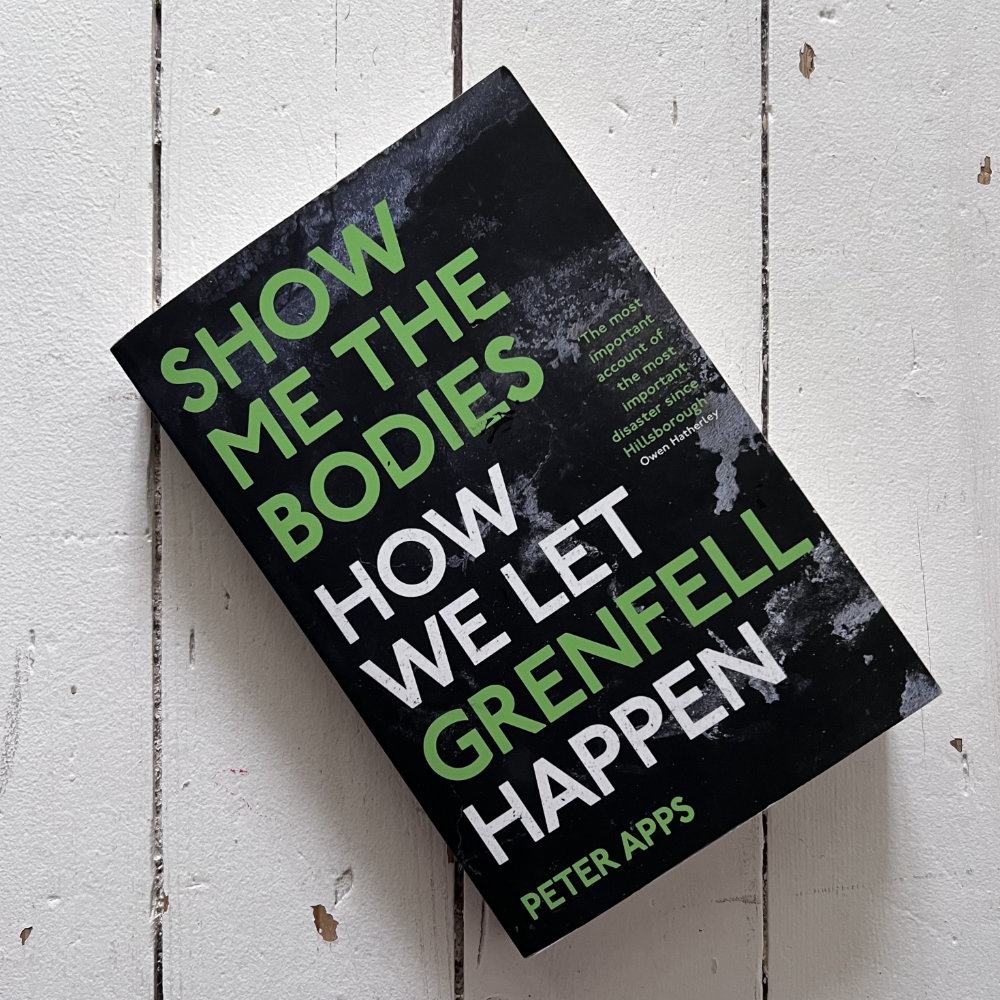
This book will make you sad, furious, ashamed and disgusted by the industry we work in
I wasn’t looking forward to reading ‘Show me the bodies; How we let Grenfell happen’, Peter Apps’ comprehensive account of the Grenfell Tower tragedy but finally plucked up the courage to read it over Christmas. It wasn’t the most seasonal choice of reading but there’s never a good time to read a detailed analysis of one of the worst tragedies in UK history. It was, as expected, utterly heartbreaking. Apps portrays the lives of those that survived, and many that didn’t, vividly and touchingly. Sadly it feels that these human stories have become lost amongst technical discussions around regulations, cladding and procurement. They are incredibly hard to bear.
I had closely followed the aspects of the enquiry relating to the refurbishment of the tower. However, Apps’ excellent book broadens out the context, setting the tragedy against decades of failure dating back to the post-war era whereby successive governments have sought to house an ever-growing population as quickly as possible whilst simultaneously deregulating, privatizing, fragmenting, under-resourcing and under-funding the sector. In short dismantling every mechanism and lever at their disposal to ensure the delivery and management of quality housing that serves residents’ needs and which stands the test of time. Before describing the tragic events of 14th June 2017 the story settles momentarily on Lakanal House in Southwark where a fire in 2009 resulting in six deaths displayed all the warning signs necessary to head off future disasters. An inquest was undertaken and the government swore to learn lessons, yet just eight years later an uncannily similar fire at Grenfell Tower would result in the deaths of 72 people.
My overwhelming feeling on reading the book was of shame and disgust at being part of the construction sector that let this tragedy happen. It is clear that almost no element of our industry is fit for purpose. Policy is focused on deregulation and delivering as cheaply as possible at the expense of quality, planning and building control departments are under-resourced and under-funded, regulatory bodies are privatized and beholden to commercial interests. Within the housing sector, in particular, there seems to be a fundamental lack of understanding about how to deliver quality. Procurement favours low fees over demonstrable ability to deliver, scopes are cut to the bone, timescales and budgets are unrealistic, and responsibility is abdicated to contractors through design and build, without any effective mechanism for ensuring quality except lazily-written employer’s requirements. More than five years have passed since Grenfell and yet we still see these same traits continuing day-in, day-out with little evidence that much has changed.
Coincidentally I read Show me the bodies on the way to see The Carpenters Line at Japan House. This exhibition explores the skillful timberwork of joiners in the densely forested Hida region of Gifu prefecture in central Japan. It was an odd juxtaposition that starkly demonstrated how our own culture has gone awry. The obsessive attention to detail, precision, care and craft of these Japanese joiners sat in direct opposition to our own focus on profit, speed, spreadsheets, arse-covering and box-ticking. A bosh-it-up and clock-off culture.
The primary function of a home is security. Security for you, your family and your loved ones. Our collective attitude towards housing in this country has resulted in delivering thousands of sub-standard homes that undermine this very sense of security. The faults, incompetence and shortcomings identified by Apps are so wide-ranging in their breadth and depth that it is all too easy to gloss over the role of thearchitect and look elsewhere for the failings in the system; it’s design and build, lack of clarity in the regulations, the behaviour of cynical contractors and suppliers, an incompetent government. Indeed this buck-passing and finger-pointing was noted during the inquiry by Richard Millett QC. But as a profession, it’s critical that we self-reflect and challenge ourselves to improve our own standards. Here are some suggestions. Let’s stop cutting our own fees to such an extent that we can’t deliver a professional, competent service, let’s stop fetishising over visual appearance and get a better grasp of how buildings are put together, let’s re-establish our position at the heart of the construction process, close to the client, so we can advise on how to deliver quality, on design and build projects lets advocate for a client-side architect as design guardian to maintain quality throughout construction and let’s advocate every single day for quality across the board.
At this time of year my social media streams are dominated by architects, consultants, contractors and clients bigging themselves up with their successes of the last year and displaying their exciting emerging projects. Instead of this hubris, I’d suggest that it’s time to be a bit more humble to reflect that collectively we’re not doing that well, that the entire industry needs a complete change of attitude, with a greater focus on care, quality, craft and a greater consideration of the people that will ultimately draw out their lives in the buildings we create. Whether you’re a policy-maker, regulator, client, architect, student, consultant, contractor, sub-contractor, supplier or manufacturer, I’d urge you to read this book. It should make you sad, furious, ashamed and disgusted by the industry we work in and determined to change it for the better.
Read the full article here.